
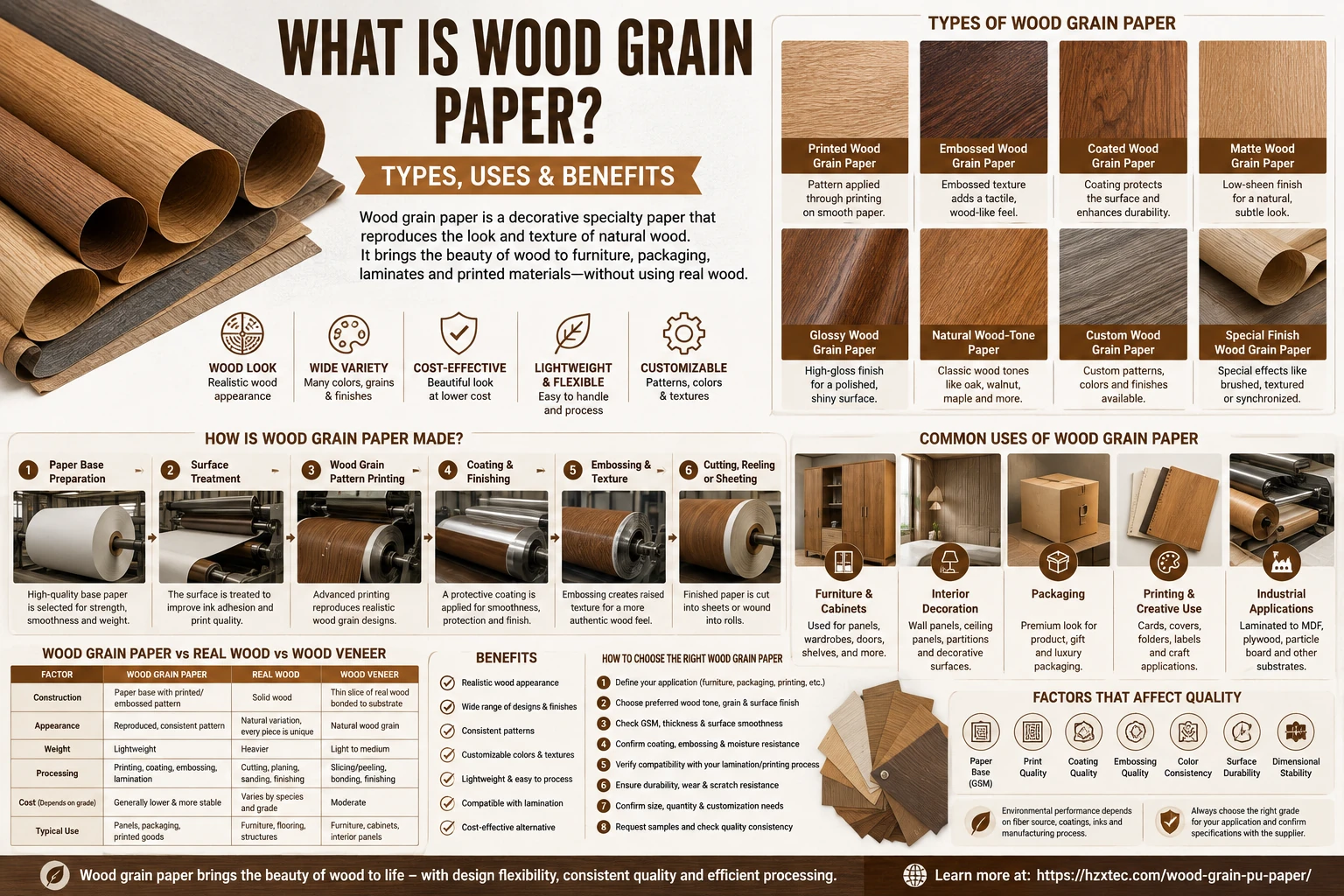
Wood grain paper is a decorative specialty paper engineered to reproduce the visual appearance of natural wood, its color, tone, and grain pattern on a flat, flexible, paper-based surface. It gives manufacturers a way to bring a wood-inspired look to furniture panels, packaging, and printed materials without using solid wood itself. This guide explains what wood grain paper is, how it’s made, the types available, where it’s used, and how to evaluate quality when choosing a supplier.
What Is Wood Grain Paper?
Wood grain paper is a printed or textured decorative paper designed to visually resemble the color and grain pattern of natural wood. It is produced by applying wood-toned patterns to a paper base through printing, embossing, or a combination of both and is commonly used as a surface material for furniture panels, decorative laminates, packaging, and printed goods.
The name comes directly from what it depicts: manufacturers reproduce recognizable wood characteristics grain lines, knots, tonal variation onto paper so the final sheet can be applied to a surface (such as MDF, particleboard, or plywood) or used directly as a decorative material. Because it reproduces a look rather than being made from solid wood, it is classified as a decorative or specialty paper, not a wood product.
It’s worth noting that wood grain paper is closely related to but not always identical to other industry terms such as finish foil, impregnated decorative paper, and decor paper. These often describe wood grain paper at different stages of processing (for example, before or after treatment with resin for panel lamination), so buyers should confirm exactly which construction a supplier is offering rather than assuming the terms are interchangeable.
How it differs from real wood or wood veneer: real wood and wood veneer are made from actual timber veneer being a thin slice of real wood bonded to a substrate. Wood grain paper is a paper-based material that reproduces a wood appearance. It does not contain wood grain in the structural sense; the “grain” is a visual pattern applied to the paper surface. This distinction matters for performance expectations, which are covered later in this guide.
What Does Wood Grain Paper Look Like?
Wood grain paper is designed to mimic the natural characteristics people associate with wood surfaces:
- Grain patterns that follow a directional flow, similar to how grain runs through a plank of real wood
- Wood-tone colors, typically ranging through light birch and maple tones, mid-range oak and walnut browns, and darker mahogany or espresso shades
- Knots and natural variation, included in the pattern design to increase realism
- Light and dark shading within the grain lines to simulate depth
- Surface texture options, from smooth and flat to raised, embossed textures that can be felt as well as seen
- Matte or glossy finishes, depending on the coating applied during manufacturing
The exact patterns, tones, and finish options available depend on the manufacturing process and the specific product line a supplier offers not every wood grain paper product includes every visual feature described above.
How Is Wood Grain Paper Made?
Wood grain paper connects to the broader craft of specialty paper manufacturing. While exact processes vary by manufacturer and product line, production generally follows these stages.
1. Paper Base Preparation
Production starts with a paper substrate, or base paper, chosen for the weight (GSM), smoothness, and strength the end application requires. The base paper provides the structural foundation that later printing, coating, and finishing steps are applied to.
2. Surface Treatment
Before decorative printing, the paper surface is often treated to improve how well it accepts ink or coating. This step affects color consistency, print sharpness, and how well later layers bond to the paper.
3. Wood Grain Pattern Printing
The wood grain design is reproduced onto the paper using industrial printing methods suited to continuous, high-volume decorative paper production. The specific printing technology used varies by manufacturer and should be confirmed directly with a supplier rather than assumed.
4. Coating and Finishing
A coating may be applied over the printed pattern. Coatings can influence:
- Surface appearance (matte vs. glossy)
- Smoothness and hand-feel
- Print protection
- Compatibility with downstream lamination or converting processes
5. Embossing and Texture
Some wood grain paper products go a step further and add physical texture through embossing, pressing a grain-like relief pattern into the paper surface. This is distinct from printing:
- Printed wood grain reproduces the visual pattern only the surface remains smooth.
- Textured or embossed wood grain adds a tactile dimension, so the surface can be felt as well as seen.
Some products combine both a printed pattern paired with embossing for a closer wood-like impression.
6. Cutting, Reeling, or Sheeting
Finished paper is converted into the format the customer needs cut sheets, reels, or rolls ready for shipment or for further lamination onto panel substrates.
Types of Wood Grain Paper
Wood grain paper is generally classified by how the pattern is applied and finished, rather than by a single fixed standard. Common categories include:
Printed Wood Grain Paper
The wood grain pattern is applied through printing onto a smooth paper base. This is the most common and cost-efficient way to reproduce a wide range of wood tones and grain designs.
Embossed Wood Grain Paper
An embossed relief texture is pressed into the paper to add a tactile, wood-like surface feel in addition to the visual pattern.
Coated Wood Grain Paper
A protective or decorative coating is applied over the printed pattern, which can affect gloss level, smoothness, and resistance to surface wear.
Matte Wood Grain Paper
Finished with a low-sheen surface for a more understated, natural look often preferred for interior applications where a subdued finish is desired.
Glossy Wood Grain Paper
Finished with a reflective surface that gives the wood pattern more visual depth and shine, often used where a more polished appearance is required.
Natural Wood-Tone Paper
Uses common, neutral wood-inspired color palettes browns, beiges, and tans designed to read as classic, universally familiar wood tones.
Custom Wood Grain Paper
Some manufacturers can develop custom patterns, colors, or finish combinations to match a buyer’s specific design requirements. Availability of custom development depends on the individual manufacturer’s capabilities, so buyers should confirm this directly.
What Is Wood Grain Printable Paper?
“Wood grain printable” paper refers to paper stock designed to be compatible with a printing process either an industrial printing line producing the wood grain pattern itself, or, in smaller-scale/craft contexts, paper meant to be printed on at home or in small print runs.
For industrial and B2B use, printability depends on several factors:
- Surface smoothness — an evenly finished surface allows more consistent ink transfer
- Ink adhesion — how well the paper’s surface treatment allows ink to bond without smudging or lifting
- Drying behavior — paper construction affects how quickly and evenly ink sets
- Base paper construction — weight, coating, and treatment all influence how a pattern prints
Because printing requirements vary by paper construction and by the printing method used, buyers producing wood grain paper at scale should confirm compatibility with their specific printing equipment and ink system directly with the paper manufacturer rather than relying on general specifications alone.
(Note: a large share of public search results for “wood grain printable” relate to consumer downloadable digital patterns for home printing and crafts a different market from industrial wood grain decorative paper. This guide focuses on the industrial/decorative paper context.)
What Is Paper That Looks Like Wood?
“Paper that looks like wood” is a broader, more general phrase than “wood grain paper.” It can refer to several different decorative paper or paper-adjacent products, depending on:
- The type of surface design used (printed pattern vs. embossed texture vs. both)
- Whether the material is intended for industrial lamination or for stationery/craft use
- The coating or finish applied
- The end use — furniture surfacing, packaging, printing stock, or decorative craft paper
In practice, “wood grain paper” is typically the more precise industry term for decorative paper used in furniture, panel, and packaging applications, while “paper that looks like wood” is often used more loosely including by consumers searching for wood-patterned craft paper, wrapping paper, or stationery.
Common Uses of Wood Grain Paper
Furniture and Decorative Surfaces
Wood grain paper is widely used as a surface layer for furniture panels, cabinet doors, shelving, and other decorative panel components typically laminated onto substrates like MDF, particleboard, or plywood. The specific applications suited to a given wood grain paper depend on its construction (coating, embossing, and durability characteristics).
Interior Decoration
Beyond furniture, wood grain paper is used in interior surfacing where a wood-inspired look is desired without the cost or weight of solid wood including wall panels and similar decorative interior components.
Packaging
Wood-inspired paper can be used to give packaging a natural, premium, or rustic visual identity — for product packaging, gift packaging, and other presentation-focused packaging applications.
Printing and Creative Applications
Wood grain paper and related wood-patterned papers are used for cards, covers, craft projects, and other printed materials where a wood-toned aesthetic is desired.
Industrial Applications
Wood grain paper’s core industrial role is as a decorative surface layer within panel lamination processes; broader industrial uses beyond this should be confirmed against manufacturer-specific product data rather than assumed.
Benefits of Wood Grain Paper
- Wood-inspired appearance without requiring solid wood
- Wide design variety — many wood tones, grain patterns, and finish combinations available
- Consistent, repeatable patterns across production batches, which is useful for manufacturers needing uniform appearance at scale
- Customizable visual styles, depending on manufacturer capability
- Lightweight, paper-based construction, which can simplify handling and processing compared to solid wood
- Printing flexibility, supporting a range of pattern and color development
- Multiple surface finish options — matte, glossy, coated, embossed
- Compatibility with standard converting and lamination processes used in panel and packaging production
It’s important to be precise about what wood grain paper does not automatically guarantee. It is not automatically cheaper than solid wood in every scenario, more sustainable than wood by default, waterproof, or more durable than real wood these outcomes depend entirely on the specific product construction, coating, and intended application. Any such claim should be backed by the specific product’s tested specifications, not treated as a general rule.
Limitations of Wood Grain Paper
A balanced view matters as much as the benefits:
- Performance depends heavily on construction — coating, base paper weight, and lamination all affect how the finished product performs.
- Paper is not equivalent to solid wood in structural strength; it is a surface/decorative material, not a load-bearing one.
- Moisture resistance varies significantly between uncoated, coated, and impregnated constructions — some grades handle moisture far better than others.
- Surface durability varies — scratch and wear resistance depend on coating type and thickness.
- Heat resistance varies by construction and is not something to assume without checking product specifications.
- Some applications require additional lamination or protective layers to meet real-world durability requirements.
- Product suitability depends on intended use — a grade suited for decorative packaging may not be suited for high-traffic furniture surfaces, and vice versa.
Wood Grain Paper vs Real Wood
| Factor | Wood Grain Paper | Real Wood |
| Appearance | Reproduces wood look via print/emboss; consistency depends on print quality | Natural variation; every piece is unique |
| Pattern consistency | High — patterns can be repeated precisely across batches | Low — natural grain varies piece to piece |
| Weight | Lightweight, paper-based | Heavier, denser (varies by species) |
| Customization | Pattern, color, and finish can often be customized | Limited to natural wood characteristics and finishing |
| Processing | Suited to standard paper converting/lamination processes | Requires woodworking processes (cutting, planing, sanding) |
| Surface options | Matte, glossy, coated, embossed variants available | Determined by wood species and applied finish |
| Moisture resistance | Varies by coating/construction | Varies by species and treatment; generally requires sealing |
| Durability | Varies by coating and base construction | Generally higher structural durability, but varies by species |
| Cost considerations | Depends on grade, coating, and volume | Depends heavily on species, grade, and sourcing |
| Typical applications | Panel surfacing, packaging, printed decorative goods | Structural and solid-surface applications, furniture, flooring |
Performance in every row above depends heavily on the specific wood grain paper construction being compared against the specific type of real wood — this table is a general guide, not a guarantee for any individual product.
Wood Grain Paper vs Wood Veneer
| Factor | Wood Grain Paper | Wood Veneer |
| Construction | Paper base with printed and/or embossed wood pattern | Thin slice of real wood, typically bonded to a substrate |
| Appearance | Reproduced, repeatable pattern | Natural, non-repeating wood grain |
| Thickness | Generally thin, lightweight paper | Thin, but made of solid wood material |
| Processing | Paper converting, printing, coating | Wood slicing/peeling, then bonding to substrate |
| Surface treatment | Coating, embossing options | Sanding, staining, sealing |
| Applications | Panel surfacing, packaging, printed goods | Furniture, cabinetry, flooring where a real-wood surface is desired |
| Customization | Pattern/color customization via printing | Limited to available wood species and cuts |
| Performance | Depends on paper construction and coating | Depends on wood species and finishing |
In short: wood veneer is real wood; wood grain paper reproduces the appearance of wood on a paper-based decorative surface.
What Factors Affect Wood Grain Paper Quality?
When evaluating wood grain paper, look beyond appearance alone:
- Paper base (GSM/basis weight) — affects strength, opacity, and handling
- Thickness — influences durability and suitability for lamination
- Surface smoothness — affects print quality and coating adhesion
- Print quality — sharpness and color accuracy of the wood grain pattern
- Grain pattern clarity — how realistic and consistent the pattern appears
- Color consistency — batch-to-batch color matching
- Coating — type and quality of any applied coating
- Embossing quality — depth, consistency, and alignment of textured patterns
- Dimensional stability — how well the paper holds its shape during processing
- Surface durability — resistance to scratching and wear
- Suitability for the intended application — matching the product’s specification to the actual use case
Buyers should always evaluate the full specification sheet — not appearance photos alone — before selecting a wood grain paper product.
How to Choose the Right Wood Grain Paper
Selecting the right wood grain paper is a matter of matching specifications to your application:
- Define the intended application — furniture panel, packaging, printed goods, or interior decoration
- Confirm the required appearance — wood tone, grain pattern, and overall design
- Choose a surface finish — matte, glossy, or textured/embossed
- Check GSM and thickness against your processing and durability needs
- Confirm printing requirements if further printing will be done on the paper
- Confirm embossing requirements if a tactile surface is needed
- Assess moisture exposure the finished product will face in use
- Assess required surface durability for the application’s wear conditions
- Confirm compatibility with your converting process (lamination, cutting, pressing)
- Specify required sheet or roll dimensions
- Discuss customization needs with the manufacturer if a unique pattern or color is required
- Confirm quantity and production requirements, including lead times
- Ask about quality consistency across production runs
Wood Grain Paper for Different Applications
| Application | Important Characteristics |
| Furniture | Durable coating, consistent pattern, lamination compatibility |
| Decorative panels | Surface smoothness, dimensional stability, finish consistency |
| Packaging | Visual appeal, printability, weight/handling suitability |
| Printing | Ink adhesion, surface smoothness, drying behavior |
| Interior decoration | Finish quality (matte/glossy), pattern realism |
| Crafts | Ease of cutting/handling, printability, visual variety |
The ideal wood grain paper construction depends on the specific application — a grade optimized for furniture lamination is not necessarily the right choice for printed packaging, and vice versa.
Is Wood Grain Paper Environmentally Friendly?
Environmental performance is not automatic it depends on the complete material construction and lifecycle, including:
- Fiber sourcing — whether the base paper uses virgin or recycled fiber
- Recycled content, if any, in the base paper
- Coatings applied to the paper and their composition
- Inks used in the printing process
- Laminations or bonding materials used when the paper is applied to a substrate
- Manufacturing processes, including water and energy use
- End-of-life considerations, such as recyclability of the finished laminated product
Because these factors vary significantly between manufacturers and product lines, wood grain paper should not be automatically labeled “eco-friendly.” Buyers seeking sustainability information should request specific data from the manufacturer rather than relying on general claims.
Wood Grain Paper FAQs
What is wood grain paper?
Wood grain paper is a decorative specialty paper printed and/or embossed to reproduce the color and pattern of natural wood, used as a surface material for furniture, packaging, and printed goods.
What is wood grain paper used for?
It’s most commonly used as a decorative surface layer on furniture panels and cabinetry, as well as in packaging and printed materials that call for a wood-inspired look.
What is paper that looks like wood called?
It’s generally called “wood grain paper” or “wood grain decorative paper” in industrial contexts, though the phrase can also refer more loosely to wood-patterned craft or stationery paper.
Can wood grain paper be printed?
Yes — the wood grain pattern itself is typically applied through industrial printing, and some wood grain paper products are also designed to accept further printing, depending on their surface construction.
Is wood grain paper real wood?
No. It’s a paper-based material designed to visually resemble wood; it does not contain solid wood.
What is the difference between wood grain paper and wood veneer?
Wood veneer is a thin slice of real wood; wood grain paper is a paper-based decorative material that reproduces a wood appearance through printing and/or embossing.
Can wood grain paper be embossed?
Yes. Embossing presses a textured, wood-like relief pattern into the paper, adding a tactile dimension beyond the printed visual pattern.
What types of wood grain paper are available?
Common types include printed, embossed, coated, matte, glossy, natural wood-tone, and custom wood grain paper availability varies by manufacturer.
How do you choose wood grain paper?
Match the paper’s GSM, coating, finish, and durability characteristics to your specific application furniture, packaging, printing, or interior decoration and confirm specifications directly with the manufacturer.
Is wood grain paper waterproof?
Not inherently. Moisture resistance depends on the coating and construction of the specific product; some grades offer better resistance than others, but “waterproof” should not be assumed without confirmed specifications.
Conclusion
Wood grain paper gives manufacturers a flexible, paper-based way to bring a wood-inspired appearance to furniture, packaging, and printed goods without the weight, cost variability, or processing demands of solid wood. Its performance, appearance, and suitability for a given application all come down to the specifics of how it’s made: the base paper, the printing and embossing method, and the coating applied. Understanding these factors is the difference between choosing a wood grain paper that performs well for your project and one that doesn’t.
If you’re evaluating wood grain paper for a furniture, panel, or packaging application, [Internal Link: Wood Grain PU Paper] outlines the specification details for ZEXN Paper current wood grain paper product line, and our team can help match a construction to your requirements.