
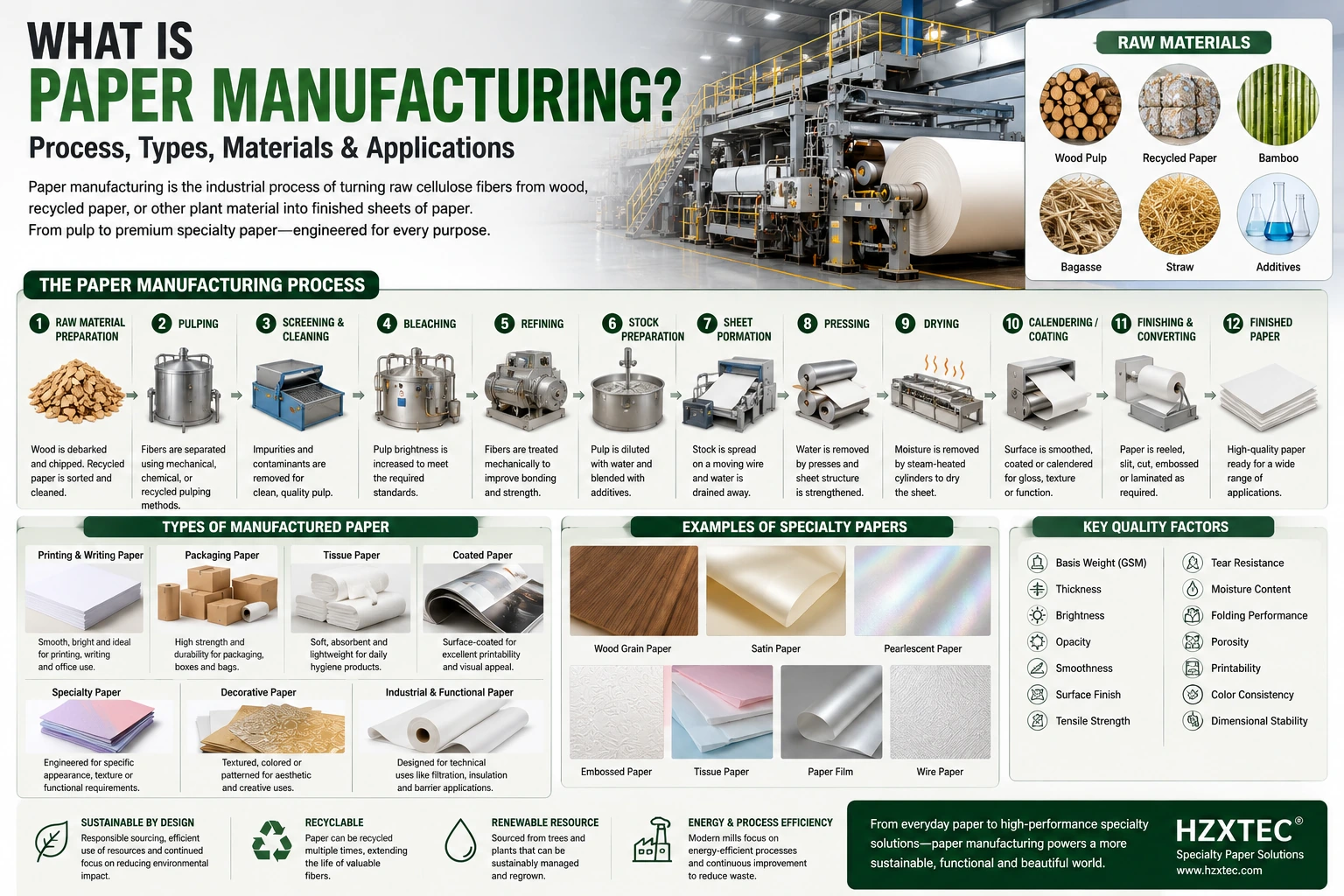
Paper manufacturing is the industrial process of turning raw cellulose fibers from wood, recycled paper, or other plant material into finished sheets of paper. It sounds simple in one sentence, but the reality is far more layered. A packaging box, a piece of printer paper, a roll of tissue, and a sheet of decorative pearlescent paper all start from the same basic idea: fibers suspended in water, formed into a sheet, and dried. What separates them is everything that happens in between which fibers are chosen, how they’re treated chemically and mechanically, and how the sheet is finished.
This guide walks through the full picture of paper manufacturing: the raw materials involved, the step-by-step production process, the major categories of paper that come out of it, and how specialty paper manufacturing builds on the same fundamentals to create paper with very specific visual, tactile, or functional properties. Along the way, we’ll also cover how paper quality is measured and controlled, how a paper manufacturer differs from a supplier or converter, and what to look for when evaluating one.
What Is Paper Manufacturing?
Paper manufacturing is the process of converting cellulose fiber sourced from wood pulp, recycled paper, or non-wood plants into continuous sheets of paper through pulping, forming, pressing, drying, and finishing. It happens inside a paper mill, where raw fiber is broken down into a fibrous slurry, spread and drained into a thin web on a moving screen, then pressed and dried into a solid sheet before being wound, cut, or converted into a final product.
The terms paper manufacturing and paper production are often used interchangeably, and in casual use that’s fine. Where a distinction is useful: “production” tends to describe the technical fiber-to-paper workflow on the machine itself, while “manufacturing” more often refers to the full operation sourcing raw material, running the mill, controlling quality, and shipping finished product. Either way, the manufacturing parameters fiber type, chemical treatment, pressing pressure, drying temperature, coating, and finishing are never fixed. They’re adjusted deliberately for each paper grade, because a tissue paper, a shipping carton liner, and a fine art print all need fundamentally different fiber structures and surface properties.
What Materials Are Used in Paper Manufacturing?
Every type of paper starts with a fiber source, plus a set of additives that shape its final properties.
Wood Pulp
Wood pulp is the dominant raw material in paper manufacturing. It comes from two broad categories of trees:
- Softwood (pine, spruce, fir): long cellulose fibers that interlock well, giving paper strength and tear resistance — commonly used where structural strength matters, such as packaging and kraft papers.
- Hardwood (birch, eucalyptus, beech): shorter fibers that pack more densely, producing a smoother, more uniform surface — favored for printing and writing papers where surface quality matters more than raw strength.
Most paper grades actually blend hardwood and hardwood pulp fibers to balance strength and smoothness rather than relying on one source alone.
Recycled Paper
Recovered paper is repulped broken back down into fiber using water and mechanical action then cleaned and, if needed, de-inked to remove printing residue before it re-enters the papermaking process. Recycled fiber shortens slightly and loses some strength each time it’s reprocessed, which is why it’s typically blended with virgin fiber rather than used at 100% concentration for higher-strength or higher-clarity grades.
Non-Wood Fibers
In regions where wood is scarce or where a specific fiber characteristic is needed, manufacturers turn to non-wood plant fibers, including bamboo, sugarcane bagasse (a byproduct of sugar processing), wheat or rice straw, and other agricultural residues. These fibers can offer useful properties bagasse and bamboo, for instance, are widely used as fast-renewing alternatives to wood pulp but their fiber characteristics and processing requirements differ from wood pulp, so they’re generally best suited to specific grades rather than a universal substitute.
Chemicals and Additives
Beyond fiber, paper manufacturing relies on a set of functional additives:
- Fillers (such as calcium carbonate or clay) improve opacity, smoothness, and printability while reducing fiber use
- Sizing agents control how paper absorbs liquid, from ink to moisture
- Dyes and pigments set the paper’s color
- Retention aids help fine fibers and fillers bind into the sheet instead of washing out
- Strength additives reinforce wet or dry tensile strength
- Coating materials (clay, latex, pigments) are applied to the surface for gloss, smoothness, or printability
The mix and dosage of these additives is one of the biggest levers manufacturers use to differentiate paper grades without changing the base fiber.
How Is Paper Manufactured?
This is the core of paper manufacturing the sequence that turns raw fiber into a finished sheet.
1. Raw Material Preparation
Wood arrives as logs, which are debarked and chipped into small, uniform pieces to ensure even, efficient pulping. Recycled paper is sorted to remove contaminants like plastic, metal, and non-paper materials before it’s reprocessed. Non-wood fibers go through their own preparation steps suited to the plant material involved.
2. Pulping
Pulping breaks fiber sources down into a workable fiber slurry, and the method used affects the final paper’s character:
- Mechanical pulping grinds wood into fiber, preserving most of the wood’s original mass but leaving lignin (the compound that binds wood fibers together) in the pulp producing a high-yield but less stable pulp typically used for products like newsprint.
- Chemical pulping (most commonly the kraft process) uses chemicals to dissolve lignin and separate cellulose fibers cleanly, producing a stronger, more stable pulp at a lower yield the basis for most higher-quality printing, writing, and packaging papers.
- Recycled-fiber pulping repulps recovered paper mechanically in water, with cleaning and de-inking stages layered in as needed.
3. Screening and Cleaning
Before moving forward, the pulp passes through screens and cleaners that remove uncooked wood fragments, plastic contaminants, and other debris. Skipping this step shows up later as visible defects, weak spots, or discoloration in the finished sheet.
4. Bleaching
Bleaching removes residual color from the pulp to increase brightness, using a sequence of chemical stages rather than a single step. Not every paper is bleached how far a pulp is bleached depends entirely on the target product, since packaging-grade paper generally doesn’t need the brightness a fine writing paper does.
5. Refining
Refining mechanically treats the fibers to develop their bonding potential improving how well fibers interlock with each other, which affects the paper’s eventual strength, drainage rate on the machine, and formation quality (how evenly the fibers distribute in the sheet).
6. Stock Preparation
The refined pulp now called “stock” is diluted heavily with water and blended with the fillers, sizing agents, and other additives selected for that specific grade, forming a highly dilute slurry ready for the paper machine.
7. Sheet Formation
The stock is fed through a headbox, which spreads it evenly across the full width of a moving synthetic mesh called the forming section or wire section. As the slurry moves along the wire, gravity and suction drain most of the water away, leaving behind a wet, fragile web of interlocked fibers this is the moment loose fiber slurry actually becomes a continuous sheet.
8. Pressing
The wet sheet moves into the press section, where it’s carried through rollers that mechanically squeeze out a large share of the remaining water. Pressing also consolidates the fiber structure, which directly affects the density and strength of the finished paper.
9. Drying
The pressed sheet travels over a long series of steam-heated drying cylinders that evaporate the remaining moisture. Drying is typically the most energy-intensive stage of the whole process, and it has to be tightly controlled dry too fast or unevenly and the sheet curls, cracks, or ends up with inconsistent moisture across its width.
10. Calendering
After drying, the sheet can pass through a calender a stack of hard rollers that compress the surface under pressure. Calendering reduces thickness variation and increases smoothness and gloss, which is why heavily calendered papers feel noticeably smoother than uncalendered ones.
11. Coating
Many paper grades receive a surface coating of pigments, latex, or other compounds to improve printability, surface appearance, or a functional property like grease or moisture resistance. Coated papers include glossy magazine stock and many packaging grades; plenty of paper from kraft to most office paper is never coated at all, because the application doesn’t call for it.
12. Finishing and Converting
The finished sheet is reeled, then depending on its end use, it may be slit into narrower rolls, cut into sheets, embossed with a texture, laminated to another material, or otherwise converted into its final saleable form.
Paper Manufacturing Process at a Glance
| Stage | What Happens |
| Raw material prep | Wood debarked/chipped; recycled paper sorted; other fibers prepared |
| Pulping | Fiber source broken down into pulp (mechanical, chemical, or recycled) |
| Screening & cleaning | Contaminants and unwanted material removed |
| Bleaching | Pulp brightness adjusted for the target grade |
| Refining | Fiber bonding potential developed |
| Stock preparation | Pulp diluted and blended with fillers/additives |
| Sheet formation | Slurry spread via headbox, drained on the wire into a wet web |
| Pressing | Mechanical water removal, sheet consolidation |
| Drying | Remaining moisture removed via heated cylinders |
| Calendering / coating | Surface smoothness, gloss, or function added |
| Finishing / converting | Reeling, slitting, sheeting, embossing, laminating |
What Types of Paper Are Manufactured?
| Paper Type | Main Characteristics | Common Applications |
| Printing & writing paper | Smooth, uniform, controlled brightness | Books, office paper, stationery |
| Packaging paper | High strength, tear resistance | Boxes, bags, wrapping, liners |
| Tissue paper | Low basis weight, high softness and absorbency | Facial/bath tissue, napkins, wipes |
| Coated paper | Surface-coated for gloss and printability | Magazines, brochures, premium packaging |
| Specialty paper | Engineered surface/functional properties | Décor, industrial, technical uses |
| Decorative paper | Textured, colored, or patterned finishes | Gift packaging, stationery, branding |
| Industrial & functional paper | Barrier, insulation, or filtration properties | Filters, release liners, industrial wraps |
Printing and Writing Paper
Made for smoothness, brightness, and consistent ink or toner behavior this category covers everything from office paper to books and fine stationery.
Packaging Paper
Prioritizes tensile and tear strength over surface finish, since it needs to protect and contain products through handling, shipping, and storage.
Tissue Paper
Manufactured at very low basis weight with a focus on softness and absorbency, often using a creping process during drying to add bulk and texture.
Coated Paper
Standard paper with a functional or decorative surface coating applied, used anywhere printability, gloss, or a specific surface feel matters more than raw fiber cost.
Specialty Paper
A broad category engineered for a specific visual, tactile, or functional requirement beyond standard printing or packaging use covered in depth below.
Decorative Paper
Paper finished with texture, color, metallic effects, or pattern for aesthetic use in packaging, branding, and interior surfaces.
Industrial and Functional Paper
Paper engineered for a technical role filtration, insulation, release properties, or barrier performance rather than for printing or appearance.
What Is Specialty Paper Manufacturing?
Specialty paper manufacturing is the process of engineering paper for a particular appearance, texture, printing behavior, strength, or functional performance requirement, rather than for general-purpose printing or packaging use. A standard sheet of paper is designed to do many things reasonably well; a specialty paper is designed to do one thing very well hold a metallic shimmer evenly, replicate the texture of real wood, resist moisture, or carry a specific coating without cracking.
Specialty paper manufacturing can draw on several of the tools already described in this guide, layered together in different combinations depending on the product:
- Careful fiber selection for base strength and stability
- Functional or aesthetic additives blended into the stock
- Surface coatings (including PU or other polymer coatings) for texture, durability, and finish
- Embossing to create raised or textured patterns
- Lamination to combine paper with another material
- Tight control of basis weight for a consistent hand-feel
- Custom specifications built around a specific end application
Not every specialty paper uses every one of these processes — a pearlescent paper’s distinguishing feature is typically its pigment and coating, for example, while a wood grain paper’s is its embossing. The engineering is matched to whatever property the product is actually built to deliver.
Examples of Specialty Papers
Wood grain paper is embossed and often surface-coated (frequently with a PU coating) to replicate the visual texture and grain pattern of real wood. It’s widely used in furniture decoration, wall panels, and packaging where a natural wood look is wanted without the cost or weight of actual wood veneer. See HZXTEC’s Wood Grain PU Paper for an example of this category.
Satin paper has a smooth, subtly lustrous surface finish that sits between matte and high gloss. It’s used in stationery, premium packaging, and in a related but distinct product also called NCR or carbonless paper for multi-part forms that transfer an impression without carbon sheets. See HZXTEC’s Satin Paper category.
Pearlescent paper carries a pigment that produces a soft, shimmering, pearl-like sheen as light hits it at different angles. It’s a common choice for premium packaging, greeting cards, and branding materials that need a distinctive, upscale visual effect.
Embossed paper is mechanically pressed with a patterned roller to create a raised or textured surface — anything from a subtle linen texture to a deep, dimensional pattern used across décor, packaging, and stationery. See HZXTEC’s Pearlescent Paper & Embossed Paper category.
Tissue paper is engineered at a very low basis weight for softness and absorbency, typically through mechanical creping during the drying stage. See HZXTEC’s Tissue Paper category.
Paper film refers to paper engineered or laminated to behave more like a film offering properties such as added strength, a smooth barrier-like surface, or specific optical characteristics used in applications where standard paper’s porosity or texture isn’t suitable. See HZXTEC’s Paper Film Series.
Wire paper (sometimes called steel-wire or metallic-textured paper) uses embossing and coating to create a fine linear or metallic wire-like surface texture, popular in modern packaging and décor applications. See HZXTEC’s Steel Wire PU Paper.
What Factors Determine Paper Quality?
| Quality Parameter | Why It Matters |
| GSM / basis weight | Determines how heavy, thick, and rigid the paper feels for its use case |
| Thickness | Affects stiffness, opacity, and how the paper handles in production |
| Moisture content | Impacts dimensional stability and how the paper runs on press or converting equipment |
| Brightness | Affects how vivid printed colors appear and overall visual appeal |
| Opacity | Determines whether printing shows through from the reverse side |
| Smoothness | Affects print sharpness and surface feel |
| Surface finish | Determines gloss, texture, and tactile quality |
| Tensile strength | Determines resistance to tearing or breaking under tension |
| Tear resistance | Affects durability during handling and end use |
| Folding performance | Important for packaging, cards, and multi-fold applications |
| Porosity | Affects ink absorption, breathability, and coating performance |
| Printability | Determines how well ink, coatings, or finishes adhere and render |
| Color consistency | Ensures uniform appearance across a production run |
| Dimensional stability | Affects how the paper behaves under humidity or temperature changes |
GSM (grams per square meter), also called basis weight, is the most commonly referenced quality spec because it’s the fastest way to communicate how heavy and substantial a paper is a 40 GSM tissue and a 300 GSM decorative cardstock are built for entirely different jobs, even if they share a fiber base.
How Do Paper Manufacturers Control Quality?
Quality control runs through every stage of manufacturing rather than being a single inspection at the end:
- Raw-material inspection checks incoming pulp or recycled fiber for consistency and contamination before it enters production
- Fiber quality monitoring tracks fiber length, freeness, and bonding characteristics through pulping and refining
- In-process monitoring tracks consistency, moisture, and formation as the sheet moves through the machine
- Moisture and basis-weight control use sensors on the paper machine to catch and correct variation in real time
- Thickness and surface testing confirm the sheet meets its caliper and finish specification
- Strength testing (tensile, tear, burst, fold) validates that the paper will perform as expected in its end use
- Appearance inspection catches visible defects — spots, streaks, holes, color variation — before the roll is finished
- Finished-product and batch testing confirms that what ships matches the agreed specification, roll to roll and order to order
The specific tests and tolerances applied always depend on the paper grade and its intended application a packaging liner and a decorative specialty paper are tested against very different priorities.
What Is the Difference Between a Paper Manufacturer and a Paper Supplier?
This distinction matters more than it might seem, especially when comparing companies that market themselves as “paper manufacturers.”
Paper Manufacturer: produces paper directly, running the pulping, forming, pressing, and finishing operations described above either from raw fiber or from purchased base paper that it processes further.
Paper Supplier / Distributor: sources paper manufactured by one or more producers and resells or distributes it, without necessarily operating production equipment itself.
Paper Converter: takes finished or semi-finished paper and transforms it into another product or format through processes like coating, laminating, slitting, sheeting, embossing, printing, or die cutting.
In practice, these roles overlap. Many specialty paper businesses manufacture base paper and also convert it in-house applying coatings, embossing, or lamination while others buy base paper from a mill and specialize purely in conversion. Neither model is inherently better; what matters for a buyer is understanding which parts of the process a given company actually controls, since that affects lead times, customization options, and quality consistency.
How to Choose a Paper Manufacturer
For B2B buyers, evaluating a paper manufacturer usually comes down to a similar set of questions regardless of the paper category involved:
- Product range: does their catalog cover the specific paper type, finish, and weight range you need?
- Manufacturing capability: do they produce the base paper themselves, or convert/resell paper made elsewhere?
- Customization: can they adjust weight, color, texture, or coating to a custom specification?
- Consistent quality: what quality-control process do they run, and can they demonstrate batch-to-batch consistency?
- Technical support: can their team advise on the right paper for your specific application?
- Production capacity: can they realistically support your order volume and any future scale-up?
- Certifications: are relevant industry or environmental certifications available where applicable to your market?
- Sampling: do they provide samples before committing to a production run?
- Minimum order requirements: do their MOQs fit your business size and order pattern?
- Packaging and logistics: how is product packaged for transit, and what does that mean for damage risk?
- Lead times: are stated production and shipping timelines realistic and consistently met?
- Export capability: do they have experience shipping to your region, including the associated documentation?
- Documentation: can they provide the specification sheets, test data, or compliance documents your business needs?
Weighing these factors together rather than price alone is generally what separates a dependable long-term paper manufacturing partner from a one-off vendor.
Paper Manufacturing and Sustainability
Sustainability in paper manufacturing is genuinely important, but it isn’t automatic it depends on how the paper is actually made, not just the fact that it’s paper.
Key factors that determine a paper product’s environmental footprint include:
- Fiber sourcing: whether virgin fiber comes from responsibly managed forests, and how much recycled fiber is blended in
- Water management: how much process water is used and how effectively it’s treated and reused
- Energy consumption: drying, in particular, is energy-intensive, so energy source and efficiency matter
- Waste and process efficiency: how much fiber, water, and material is lost or recovered during production
- Coatings and additives: some coatings can make paper harder to recycle or biodegrade, depending on the chemistry used
- Product recyclability: whether the finished product including any lamination or coating can realistically be recycled
- End-of-life management: how the product is actually disposed of or recovered after use
It’s worth being direct about this: paper is not automatically “eco-friendly” simply because it isn’t plastic. A heavily laminated, multi-coated specialty paper can have a very different environmental profile than an uncoated recycled-fiber sheet. Buyers who care about sustainability should ask manufacturers specific questions about fiber sourcing, energy use, and recyclability rather than relying on general claims.
Common Applications of Manufactured Paper
Paper’s applications track closely to the properties built into each grade:
- Printing and publishing rely on smoothness, brightness, and opacity for sharp, consistent output
- Packaging depends on strength, tear resistance, and — increasingly — barrier or moisture-resistance properties
- Furniture and decorative surfaces use embossed and coated specialty papers (like wood grain paper) for texture and appearance without the cost of natural materials
- Advertising and branding materials lean on decorative finishes — pearlescent, satin, embossed — for shelf appeal and tactile brand experience
- Food packaging (where applicable) requires food-contact-appropriate materials and often specific barrier properties
- Industrial applications use functional papers engineered for filtration, release, or insulation performance
- Personal care products depend on tissue-grade paper’s softness and absorbency
- Creative and craft products use specialty finishes for their visual and tactile qualities
Frequently Asked Questions About Paper Manufacturing
What is paper manufacturing?
Paper manufacturing is the industrial process of converting cellulose fiber from wood pulp, recycled paper, or other plant sources into finished paper sheets through pulping, forming, pressing, drying, and finishing.
How is paper manufactured?
Fiber is pulped into a slurry, cleaned and bleached as needed, refined, then diluted and spread across a moving screen where water drains away to form a wet sheet. The sheet is then pressed, dried, and finished with steps like calendering, coating, or embossing depending on the grade.
What raw materials are used to make paper?
The main raw materials are wood pulp (from softwood or hardwood), recycled paper fiber, and in some regions non-wood fibers like bamboo or bagasse, combined with additives such as fillers, sizing agents, and dyes.
What is the paper manufacturing process?
It’s the full sequence from raw material preparation through pulping, screening, bleaching, refining, stock preparation, sheet formation, pressing, drying, and finishing described stage by stage earlier in this guide.
What is the difference between paper manufacturing and paper production?
The terms are often used interchangeably. Where distinguished, “production” typically refers to the technical fiber-to-paper workflow on the machine, while “manufacturing” covers the broader operation of running a mill end-to-end.
What is specialty paper manufacturing?
It’s the process of engineering paper for a specific appearance, texture, or functional property such as a pearlescent sheen, embossed texture, or coated surface rather than for general printing or packaging use.
What are the main types of manufactured paper?
Broad categories include printing and writing paper, packaging paper, tissue paper, coated paper, specialty paper, decorative paper, and industrial or functional paper.
How do paper manufacturers control quality?
Through inspection and monitoring at every stage raw-material checks, in-process monitoring of moisture and basis weight, and finished-product testing for strength, appearance, and dimensional consistency.
What factors should you consider when choosing a paper manufacturer?
Product range, manufacturing capability, customization options, quality-control processes, production capacity, sampling availability, lead times, and export experience are all worth evaluating together.
Is recycled paper manufactured differently from virgin-fiber paper?
Yes, recycled paper starts with a repulping and cleaning (often de-inking) stage instead of pulping raw wood, and recycled fiber is typically blended with virgin fiber since it loses some strength each time it’s reprocessed.
Conclusion
Paper manufacturing is a long chain of deliberate decisions: fiber selection, pulping method, refining, chemical treatment, pressing, drying, and finishing that together determine what a sheet of paper can do. Specialty paper manufacturing doesn’t sit apart from this process; it’s the same fundamentals applied with more precision toward a specific visual or functional outcome, whether that’s a pearlescent sheen, an embossed wood-grain texture, or a coated surface built for a particular application.
HZXTEC works within this specialty paper space, producing paper across categories including pearlescent and embossed paper, PU paper (including wood grain and wire finishes), satin paper, tissue paper, and paper film. If you’re exploring options for a specific project, browsing HZXTEC’s specialty paper categories is a reasonable next step or you can get in touch directly to discuss your paper requirements.